Research website · formerly Ludisme.com
Samuelle Ducrocq-Henry, Ph.D.
Professor and researcher at the Université du Québec en Abitibi-Témiscamingue (UQAT), Ph.D. in communication, inventor, author and artistic director. Her work connects serious games, interactive storytelling, live video-scenic shows and interspecies communication.
- Serious gaming
- Pedagogical LAN
- Research-creation
- 2D/3D creation
- Video-scenic performance
- Equine cognition

Biography
Academic, artistic, athletic and public life, updated for 2027.
Thesis: Tribes in Play
The LAN party and the “Pedagogical LAN” model.
Research
Publications, patents, serious-gaming prototypes and research-creation.
Talks and events
From the Acfas to Lyon 3 and UNESCO.
Media
TV and radio interviews (now playable online) and press coverage.
Contact
How to reach the researcher.
Welcome and research stance: “ludism”
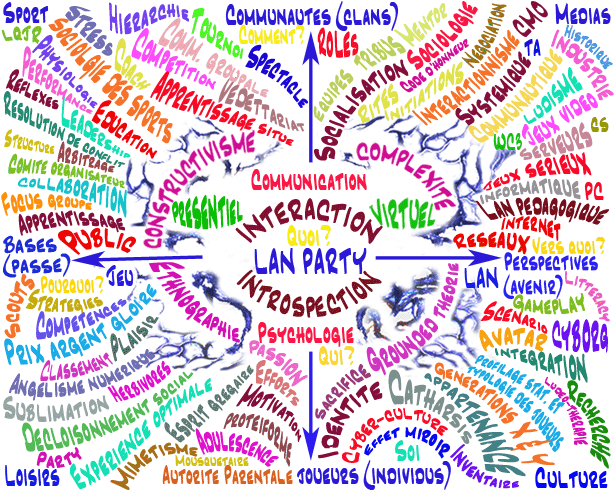
For some forty years, the Western world has been entering a new era that some call “postmodern.” Shaped by the rise of networks and cyberculture, it is marked by a quest for leisure experiences and individual happiness, amid human and technological paradoxes.
The world's population remains torn by glaring, even shameful, socio-economic gaps: we speak of a true “digital divide,” leaving aside whole areas of expertise and know-how held by people who lack training and access to the digital communication networks that otherwise drive the Western economy.
Yet the “connected” of this world are actors in and witnesses to an era of Homo communicans: a contemporary being who lives on and consumes culture and communications the way our ancestors fed on ideals. We exchange ways of being and knowing, rather than of doing, yet remain relational beings, even if increasingly at a distance. Johan Huizinga spoke of Homo ludens, the “playing human” who constantly recreates, within society, play spaces governed by a (con)secrated playground, often an institution (academic, family), and by precise rules of play, from which social customs, in the interactionist perspective, are not excluded.
We stage ourselves, juggle identities and care for our virtual image just as we would wish to save face in the presence of others. These social games, implicitly recognized by all, apply to every aspect of life in society, from the courtroom to the schoolyard. Our human customs spread across networks while our bodies remain forgotten somewhere between a chair and a wall… From hacking to collectively built wikis, we court and we wage war there, but above all we pursue self-presentation while watching over our image.
From video games to augmented reality, cyber-DJs and virtual reality, the playful stakes of our time are probably those that video-scenic perspectives will offer on the largest scale. Developed at the size of buildings, even cities, blending live performers who travel through a reality strewn with augmented-reality challenges, these are true networked games combining storytelling, scenography, human and playful performance, sound and light, interactivity and virtual projection, non-linear and in 360 degrees. The creators of these playful worlds, new video games to be lived, now write scenarios in which everyone becomes their own hero, while authors have become merchants of sensations and emotions, writing scenarios to be lived whose ambition matches the scale of our societies.
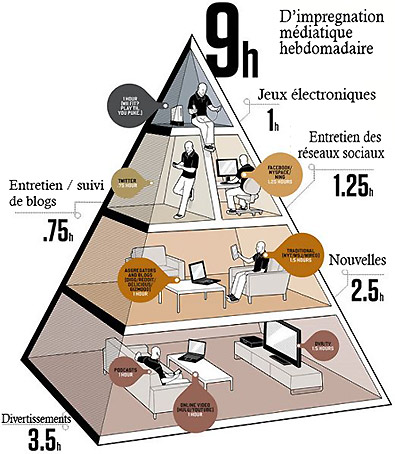
From the “Bread and circuses!” chanted by an entertainment-hungry population in the days of Roman glory, to the perpetual quest for a leisure society (reflected in laws such as France's 35-hour work week), today's surge of technological development is constantly justified by a will to free bodies from the yoke of work, while drawing minds ever further into the game of networks.
And if the figures are to be believed, this victory over time translates far less into a renewal of individual creativity than into a collective quest for plural entertainment. This playful attitude goes hand in hand with the steady growth of the whole entertainment industry: from cinema to television and reality TV (a replica of the artificial-intelligence ecosystem of some video games, through which viewers at least live by proxy), to the Internet and its potential for endlessly multiplying identities, and of course video games, coupled with a certain art of living through simulation.
I lacked a word to describe a new social attitude, a collective stance co-constructed by everyone acting in turn as producer, consumer, critic and distributor of information on the networks; a stance that values this intensive and exponential practice of playfulness, strongly reinforced since the advent of the Web by new technologies, networking in particular. This is what I call “ludism” (ludisme).
In short, ludism describes this collective, still unconscious, philosophical stance that values every form of playful virtuality and of real play in which there is an urgent need to stage oneself. It gave its name to this research website, referring to my main object of study as a researcher in communication, art and education: mediated play in all its forms, especially its most contemporary forms, centred on video games and serious gaming.
Enjoy your visit,
Samuelle D.-H.

About this website. This site revives, modernizes and updates the former Ludisme.com research website (2003-2013). External links that no longer work have been removed, but the information they referred to is kept (shown with a dotted underline). Most original documents are in French. The site is now hosted on Artsperger.com, a future space to showcase the works and creations of autistic (Asperger's) artists and researchers.