Doctoral thesis
Tribes in Play: the LAN Party
Les tribus ludiques du « LAN party » : perspectives d'apprentissage et de socialisation en contexte de compétition de jeux vidéo en réseau local. Joint Ph.D. in communication (UQAM, Université de Montréal, Concordia), defended October 21, 2010.



- Read the full thesis (in French) on Archipel, UQAM's institutional repository
- Summary of “Tribes in Play” (English)
- Preamble and introduction (French)
- The LAN party: socialization, identity and learning (presentation, French)
- Thesis defence slideshow (French)
In her thesis, Samuelle Ducrocq-Henry offers a broad panorama of the customs of a young generation fond of the virtual world, yet driven to gather at large gaming competitions called LAN parties. After studying the phenomenon in depth, she approached it from an interactionist angle, without setting aside the physiological and psychological impact of play on players, in a psychosocial and systemic approach. The LAN is studied as an ecosystem ahead of its time, blending physical and virtual presence, community and individuals, in a whole that exchanges energy and information in the form of learning and socialization. Conducted over eight years, the study also presents statistics on Generations X and Y (ages 15-35).
Its main contribution is to transfer the benefits of the LAN to institutions, so that it can serve as a group-intervention device in both training and therapy. The method set out in Chapter V invites institutions to design and run “Pedagogical LANs.” The thesis presents a theoretical equation explaining how the LAN generates remarkable, low-cost synergy among groups who need to work together and on themselves (schools, institutions, clinics). All it takes is a lab of networked computers and a popular multiplayer game or existing simulation, modified by the teaching team so that participants can experience a new pedagogical scenario.
The model was patented (INPI, no. 11 50053) and published in the Canadian Journal of Learning and Technology (read the article).
Experiment: the first Pedagogical LAN (January 22, 2010)
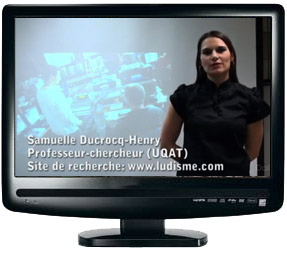
On Friday, January 22, 2010, at 6:30 p.m., in lab D-0126 of UQAT's Longueuil campus, the first “ludo-pedagogical” LAN applying the theory of the same name took place: an experimental, collective multiplayer driving-test simulation (22 participants). The filmed event was presented publicly at the thesis defence at UQAM. The first two minutes of the long version of the documentary recall the thesis's main theoretical points.
Quebec's new driver-training law, in force since January 17, 2010, emphasizes driving behaviour with others rather than individualistic behaviour. A collective driving simulation, proposed as a serious-game device, illustrates the Pedagogical LAN theory well. We used an adapted driving video game, played over a network with roles assigned to participants.
“Training a new generation of drivers means teaching them to conduct themselves, not just to drive.” (Julie Boulet, Quebec Minister of Transport, translated)
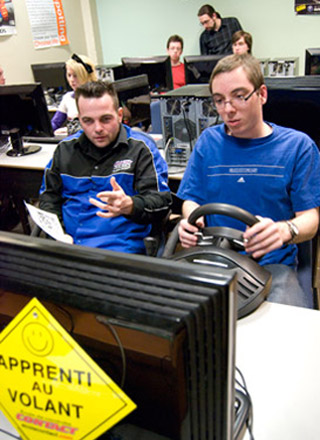
Teaching team: École de conduite Contact, Mascouche (www.ecolecontact.com). Technical direction (software and network engineering): Jonathan Marcil.
Goal: learn to drive collectively and simulate responsible driving for an examinee, by confronting them with potentially tricky road situations involving others.
Participants: 15 testers under 25, including 4 examinees who had passed the theory test but not yet the road test, plus a driving instructor, in a computer lab.
Procedure: everyone is immersed in the same game interface simulating a driving test, where each person plays a role that challenges the examinee. Some drive taxis, others police cars or play pedestrians; the professor films the in-game interactions from a helicopter carrying her avatar. In the room, everyone sits side by side to discuss, test or coach the examinees and comment on their performance. In the game, they all drive through a virtual neighbourhood powered by the GTA San Andreas engine.

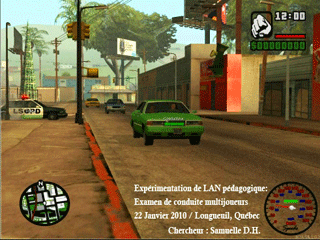
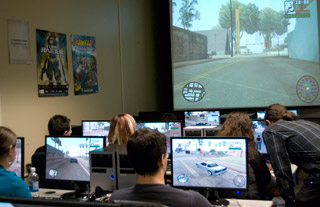
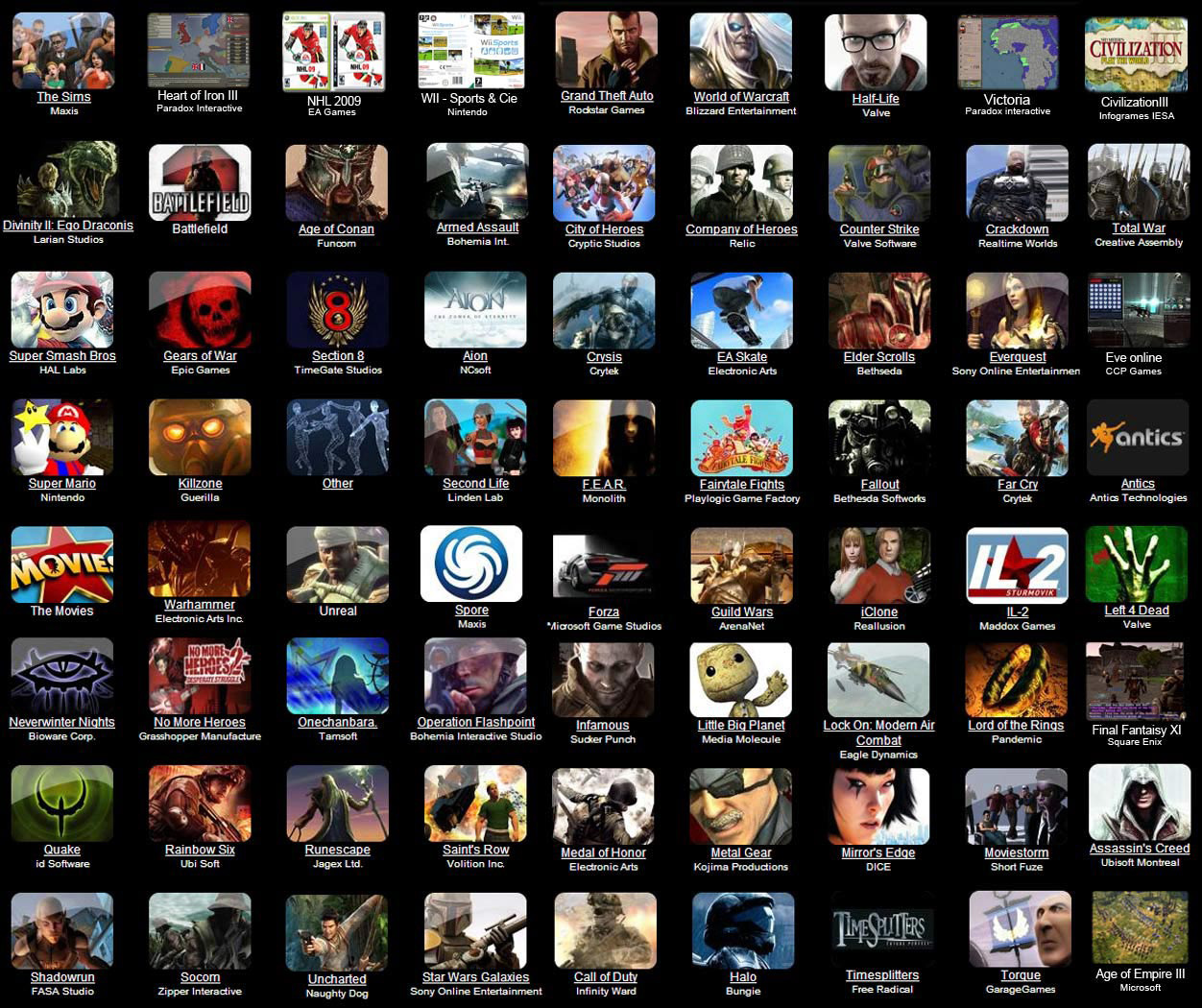
This experiment illustrates the Pedagogical LAN theory presented in Tribes in Play and shows that effective, low-cost educational prototypes can be built, in the spirit of serious gaming, by repurposing existing video games. Game suggestions are welcome.
“While they make up only 10% of licence holders, young people are involved in 24% of accidents causing death or injury.” Source: Quebec government press release, Branchez-vous.com (translated).